How to redesign the facade of your home without doing a renovation

Redesigning without work: a smart strategy
Changing a home’s exterior doesn’t always require a complete renovation. In fact, in many cases, the greatest visual impact is achieved through relatively simple decisions: improving the color palette, rearranging elements, updating lighting, or strategically introducing plants. The key is to understand the interface as a set of visual layers, not just as a surface to “fix.”
If the goal is to renovate without engaging in lengthy, expensive or invasive works, it is advisable to work with a design logic: monitor, prioritize and implement in phases. In addition, today AI tools like DecorGPT allow you to test ideas before investing, which is especially useful when you don’t want to improvise on a visual element like the exterior of a home.
Start by diagnosing what you already have
Before considering changes, it is advisable to analyze the interface with a critical but practical eye. Often the problem is not the architecture itself, but the accumulation of small factors that make a home look old, faded or cluttered.
Note these points:
- Dominant colour:Does the interface look yellowed, worn, or too flat?
- interview: Are there elements missing visually due to lack of contrast?
- size: Are doors, windows and access points well organized?
- Condition of visual materials: Rails, railings, panels, gutters, curtains.
- External lighting:Does the house look good at night too?
- Vegetation and immediate environment: Is it accompanied by architecture or a disorder in it?
Making this diagnosis helps avoid unnecessary changes. Sometimes it is enough to intervene on two or three carefully selected points to transform public perception.
Rethink color with intention
Color is one of the most powerful tools to redesign an interface without any work. It’s not just about drawing “pretty”, it’s about building a balanced visual composition.
Useful recommendations:
- Reduce the number of tones: Too many colors lead to fragmentation of the interface.
- Work with a neutral base: Off-white, warm grey, sandy or gray usually works well.
- Use a distinctive color On doors, frames, railings or small details.
- Think about the environment: A home located in a wooded area can accept deeper tones; In an urban environment, clean and sober tones usually work best.
- Don’t forget the weather and orientation: Light changes color perception a lot.
This is where an AI visualization tool comes in particularly useful. Platforms like DecorGPT allow you to explore color combinations and see how they behave on the facade before painting. This reduces common mistakes, such as choosing a shade that looks elegant in a small swatch but is too cool or intense everywhere.
Update the front door: the most cost-effective touchpoint
The entrance door is usually the element that defines the character of the exterior. Without having to change all the carpentry, you can enhance its presence with simple actions.
Low-impact and high-impact options:
- Paint the door a more expressive color.
- Replace knobs, knobs or hardware.
- Add a clearer, more contemporary house number.
- Incorporate a mailbox or lighting fixture into a cohesive design.
- Enhance access with an outdoor rug or small transitional sidewalk.
If the door is in good condition, there is no need to replace it. Sometimes it’s enough to subtract from the surrounding visual noise for it to gain prominence. A clear, well-lit entrance with matching finishes conveys interest even before entering.
Improve outdoor lighting
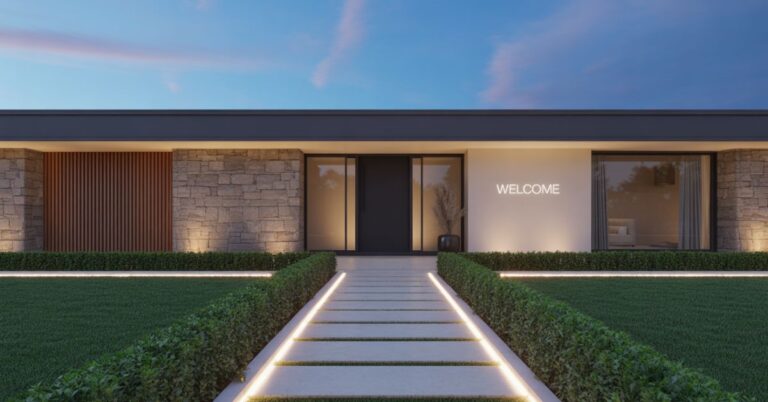
Outdoor lighting isn’t just for vision; It also builds atmosphere. A well-lit facade looks more modern, safer and well-maintained, even without major physical changes.
Practical ideas:
- Apply warm light in key points To avoid a cold or institutional feeling.
- Illuminating the main entrance To direct the eye towards the entrance.
- Highlight textures If the facade is covered with brick, stone or protruding coverings.
- Avoid excessive lighting: Too many spotlights create a flat and inelegant effect.
- Use lighting that matches the style of the home.
Good lighting can correct many visual weaknesses. Additionally, it is one of the easiest interventions to plan with the help of AI, because it allows you to compare light distributions, intensities and positions without having to install anything first.
Arrangement of visual configuration
Many interfaces do not need more elements, but rather fewer distracting elements. The exterior redesign also consists of a complete visual cleanup.
Check if you can:
- Hide visible cables or channels.
- Unifying bars, handrails and frames with the same color standards.
- Remove decorative elements that do not provide cohesion.
- Replace mismatched utensils with more compatible pieces.
- Reduce saturation of items on windows, balconies or balconies.
An interface works best when there is a clear arrangement between the primary and secondary interface. If everything is competing for attention, the result looks chaotic even if every single element is correct.
Use vegetation as a design tool, not filler
Plants can greatly improve the appearance of an exterior, but only when they are well integrated. It’s not about filling in random gaps, but using them to frame, accompany or soften the structure.
Good practices:
- Place plants at entry or transition points.
- Choose species according to the climate and the actual maintenance you can afford.
- Combining heights: floor, mid-height and some vertical elements.
- Avoid blocking windows or invading roads.
- Maintain a consistent botanical palette to make the entire look intentional.
A common mistake is to use too many small pots, which creates visual noise. Working with a few well-placed, more prominent pieces is often more effective.
Check sidewalks, edges and small details
The exterior appearance does not end at the facade. Access ledges, entrance curbs, steps, planters or plinths have important visual weight. Changing them completely may require work, but often their readability can be improved without structural intervention.
You can consider:
- Clean joints and surfaces to restore uniformity.
- Paint or seal the boards to give them continuity.
- Replace loose or damaged parts.
- Better define pedestrian routes using supplementary materials.
- Integrate access with a small landscape gesture.
These are details that cannot always be observed separately, but can be observed as a whole. In external architecture, the whole is what rules.
Try before you decide
One of the biggest advances in residential design is the ability to visualize changes before implementing them. This is especially useful when you don’t want to renovate, because every decision matters more: there is no work that will “correct” a bad aesthetic choice later.
AI tools help:
- Compare several color suggestions.
- See the effect of different lighting patterns.
- Evaluate whether simpler or warmer language is appropriate.
- Detecting imbalances in the external structure.
- Make decisions with more confidence and experience less error.
In this sense, DecorGPT is a technical and visual support within the process, not a replacement for architectural standards. It works to quickly explore alternatives and put forward ideas that, otherwise, would remain mere references or intuition.
Think in layers, not in one intervention
The best way to redesign the interface without renovation is to combine small actions that reinforce each other. The new color can work better if accompanied by a cleaner entryway, well-planned lighting, and tidier plants.
The practical sequence could be:
- Diagnose elements that detract from visual quality.
- Determine the basic color palette.
- Reinforce the door, hardware and lighting.
- Simplify the rest.
- Add greenery and brown details.
- Display the result before execution.
This layered approach allows you to transform the concept of a home without going through a major renovation. In addition, it maintains control of budget, times and scope.
conclusion
It is entirely possible to redesign the exterior of a home without renovating it if you work wisely. The interface does not necessarily require more intervention; Often times it needs better direction. Colour, light, order, vegetation and small details can completely change the way a home is perceived.
The advantage of relying on AI tools is that they allow you to predict outcomes, compare options, and reduce rash decisions. In a process where every detail matters, visualizing before acting provides clarity and confidence. This, in exterior design, often makes the difference between a simple finishing touch and a real transformation.